The AGA International Aquascaping Contest (AGAIAC) is primarily a friendly way for hobbyists to share their aquascaping efforts with each other, and to learn better techniques through the display and evaluation of those efforts. The contest will also allow hobbyists to compete for awards. The event is open to all hobbyists, regardless of age, national origin or degree of experience in the hobby.
Overview
The AGAIAC was established to showcase aquascaping in freshwater aquaria. Brackish and Marine aquaria are allowed in the Biotope category only.
Each composition is entered and judged in one of the following categories: Aquatic Garden, Classic, Biotope, Dutch, Wabi Kusa, Paludarium, or Riparium.
All categories with the exception of Biotope require that the competitor use live plants in their composition. The Biotope category is reserved for aquariums that are attempting to recreate a particular natural environment, which may not contain live plants, and as such will be judged accordingly. Read the specific guidelines for the Biotope class below.
Entry Requirements:
- Complete the entry form to include information such as their legal name (no pseudonyms), City and Country.
- Agree to the photo release.
- Supply basic information for each composition (maximum four compositions per competitor)
- Upload photographs (1-3 per composition)
Each competitor may submit a maximum of 4 compositions total per year across all categories. Attempts to enter more than four compositions, or by using multiple accounts will result in immediate disqualification of all compositions.
The composition dimensions should be measured from the bottom of the aquarium up to the water line. For example, a 60cm W × 40cm D × 40cm H would have a volume of 96L, but if it is only filled to 30cm, then it should be reported as 60cm × 40cm × 30cm and its volume as 72L.
Only one composition per physical aquarium is allowed. If changes were made to the same aquarium multiple times, whether it be a full re-scape or minor planting change, you may only submit one composition from that aquarium per year.
Compositions need not have been created in the past year. However, if you have already entered the composition in a previous AGAIAC or other contest, then new photographs taken in the last year must be used. Additionally, disqualified compositions may not be re-entered in subsequent years.
Competitors are forbidden to ask advice or show composition photos to members of the AGA Board of Directors or current contest judges. The first offense will result in a warning, and the second offense can result in disqualification of the composition. Continued attempts to contact the members of the AGA Board of Directors or judges will be considered an attempt to influence the composition’s score and will result in banning the competitor from the contest for that calendar year.
Competitors are asked to not include personal identifying information in the composition text fields or photographs. The contest committee reserves the right to remove any inappropriate identifying information if an unaltered version is not provided.
Further questions may be answered by the organizers at [email protected]
Photo Requirements
In summary:
- 1–3 Photos
- Highest Resolution Possible
- Limited editing only; no cloning, compositing, smudging, or other editing actions.
- Camera original image must be retained and provided if requested.
- Photo should not be altered to include identifiers such as a name or company logo.
- No borders or frames
- No collages (multiple photos in same image)
- No photos including people or ‘selfies’
The competitor is requested to provide 1–3 images of each composition, the primary image for the entry being a full view of the aquarium from directly in front (not at an angle), then additional photos ideally showing overall views and close-ups of details they wish to highlight may be provided supplementarily.
Entrants are encouraged to try and provide the clearest, sharpest images possible. Higher quality, clear photos will elevate your chances at a higher score as they will be better for the judges to evaluate, and will also display better for viewing in the gallery on the website. The website currently only accepts JPEG images, but there is no size or quality limit.
Photos may only receive minor adjustments for color correction, lens and distortion correction, rotation, brightness, shadow/highlight, contrast and/or sharpness. HDR filtering is permitted.
Any modification that effectively alters the content of the original image is grounds for immediate disqualification. Such alterations include, but are not limited to:
- Cloning elements of the image to remove an imperfection or improve the appearance (eg., retouching out a snail or a area of algae).
- Selectively compositing multiple images to improve the overall image (eg., creating a ‘perfect’ school of fish from parts of different photographs).
- Selectively coloring areas of the composition with a transparent solid color to artificially enhance the color of plants.
- Selectively blacking out the background to hide equipment or other flaws.
In order to maintain the integrity of the AGAIAC, we reserve the right to request the camera original photo before edits were made. It is the responsibility of the entrants to retain the original version of their submitted photo. Any entrant who is unable to provide the camera original photo when requested may be subject to disqualification.
Many competitors feel the need to add large frame borders around their photographs; this detracts from the image and will additionally result in a scaled display on the gallery pages. In these cases we will request a borderless photo be provided, or we reserve the right to crop the border out.
Images submitted should not have the photographer’s name or Copyright Notice superimposed over the image. Images should not include the competitor or other people in the picture (aka, a selfie). In order to maintain impartial judging, no identifying information will be permitted on or with submitted photos. All entry photos displayed on the AGAIAC website have permanent copyright marks.
When submitting an entry, all competitors agree to a photo release. The AGAIAC and Aquatic Gardeners Association (AGA) reserve the right to use submitted images for contest or organizational promotional purposes in digital and print format. The AGA will never sell or use images for any other purposes.
Judging and Awards
Judging will be conducted for each composition, which will be identified solely by entry number. Judging is blind, with the identity of the entrant whose composition is being evaluated hidden until after the results are released to the public. Judges will not communicate with each other while evaluating the entries.
Within each category, each judge’s ranking for the entries will be averaged to determine the overall placing of the compositions within the category. The three highest placed entries per class will receive a monetary and physical award. Overall placings 4–10 will be acknowledged as “Honorable Mention”, but do not receive cash or awards.
After the winners are tabulated, the judges will also choose a Best of Show winner from the Aquatic Garden categories. They will communicate with each other over this decision. The Premier Sponsor will also choose their Choice Award, which will be highlighted on the contest home page and alongside the other winners.
Judges are asked to provide feedback for each composition in the contest. These comments will be displayed alongside the entry details on the website. After the winners are announced, judges may be available (at their discretion) on the AGA Facebook group where competitors can post a photo and request commentary.
The decisions of the judges are final.
Aquatic Garden
The Aquatic Garden category is the most commonly entered category, and is divided by aquarium volume.
- 0–44L
- 45–89L
- 90–219L
- 220L+
Aquatic Garden Judging Criteria
1. Overall Impression (maximum 70 points)
- Does the composition make a significant positive visual impression upon the viewer?
- Do all parts of the composition work together to present a harmonious whole?
2. Composition, Balance, Use of Space, Use of Color (maximum 60 points)
- Does balance exist between the various components of the composition?
- Is space within the aquarium used effectively?
- Are the colors of the various elements of the composition (including inhabitants) complementary and do they work well together?
- Do the inhabitants compliment or detract from the overall layout?
3. Use of Materials (maximum 40 points)
- If hardscape materials are present, are they well-integrated into the composition, supporting rather than distracting from the overall layout and planting?
4. Health and Viability (maximum 30 points)
- Are the plants healthy and well maintained?
- Are the plants and inhabitants appropriate for use in the specific layout? Are they appropriate for the size of the aquarium and layout? Will the natural behavior of the inhabitants complement and be compatible with the materials and layout? Do they appear healthy and acclimated to the environment?
Classic
This category emphasizes the types of aquariums that celebrate the very element that the Aquatic Gardener’s Association was founded on: aquatic plants. Planted and cultivated with skillful care, these compositions differ from the contest’s existing Aquatic Garden category in that while they still incorporate hardscape elements, there is a foundational focus on the plants, which welcomes a broad range of artistic approaches.
Current aquascaping trends lean towards dramatic scale, extensive forced perspective, and highly stylized compositions. These layouts will still apply to the Aquatic Garden category, but are not components of this new Classic category. Classic Style entries are judged by their quality of plant husbandry, balance, and overall natural impression, rather than visual illusion or perceived size. Classic layouts should be more representative of a 1:1 scale, where the layout is close to the same size as it would be found in nature.
Classic Judging Criteria
There are four basic criteria that the judges consider when reviewing each composition:
1. Overall Impression (maximum 70 points)
- Does the composition make a significant positive visual impression upon the viewer?
- Do all parts of the composition work together to present a harmonious whole?
2. Composition, Balance, Use of Space, Use of Color (maximum 50 points)
- Is the composition presented without forced perspective or techniques that create a manipulated sense of scale?
- Does balance exist between the various components of the composition?
- Is space within the aquarium used effectively?
- Are the colors of the various elements of the composition (including inhabitants) complementary and do they work well together?
3. Selection, Use, and Health of Plants (maximum 50 points)
- Are the plants healthy and well trimmed?
- Does the composition contain a diversity of species?
- Does the composition include rare or difficult species and use them in a manner where they are integrated well?
4. Selection, Hardscape Materials, and Animals (maximum 30 points)
- Do the colors, shape, and size of the inhabitants harmonize with the plants?
- Are the inhabitants appropriate for the display and complementary of the layout and not distracting?
- If hardscape materials are present, are they well-integrated into the composition, and supportive of the overall layout and planting?
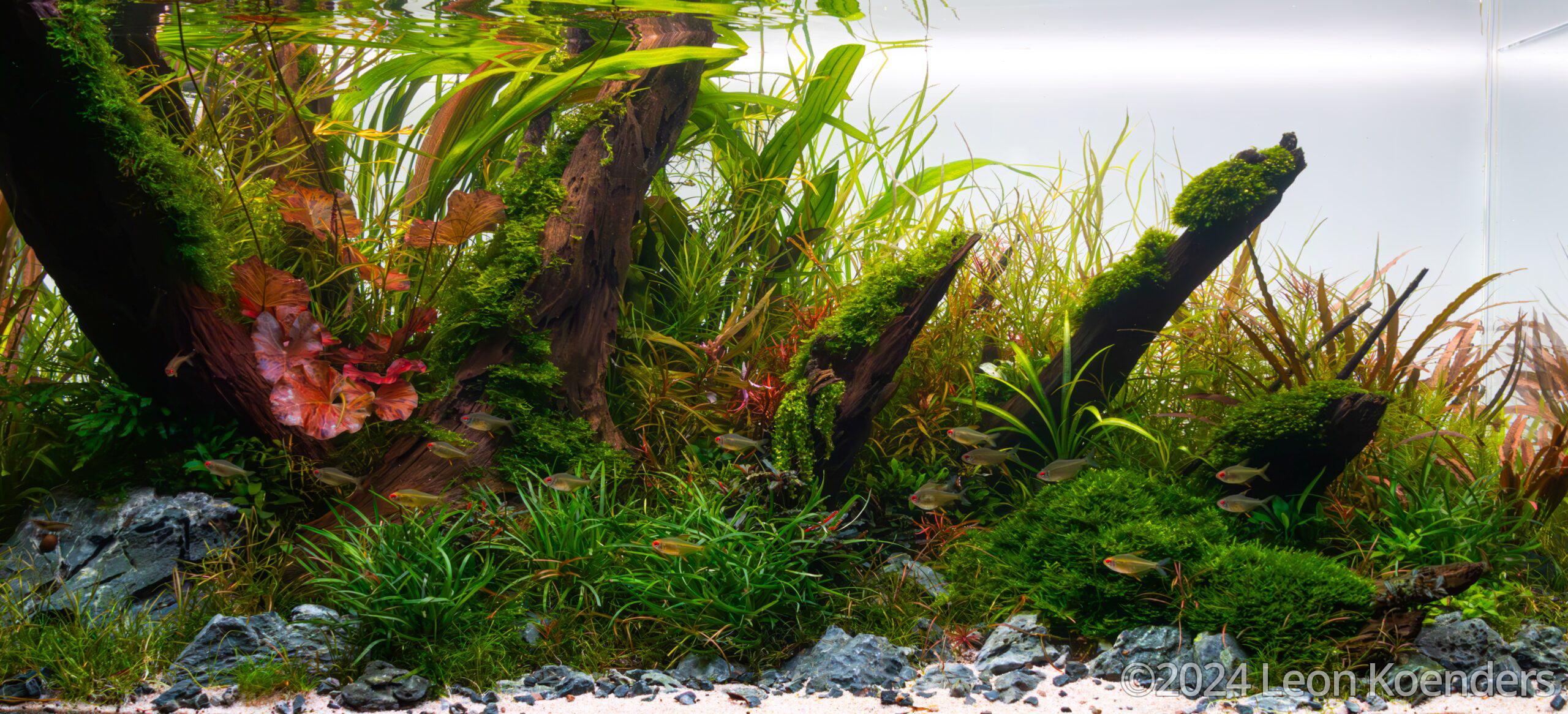
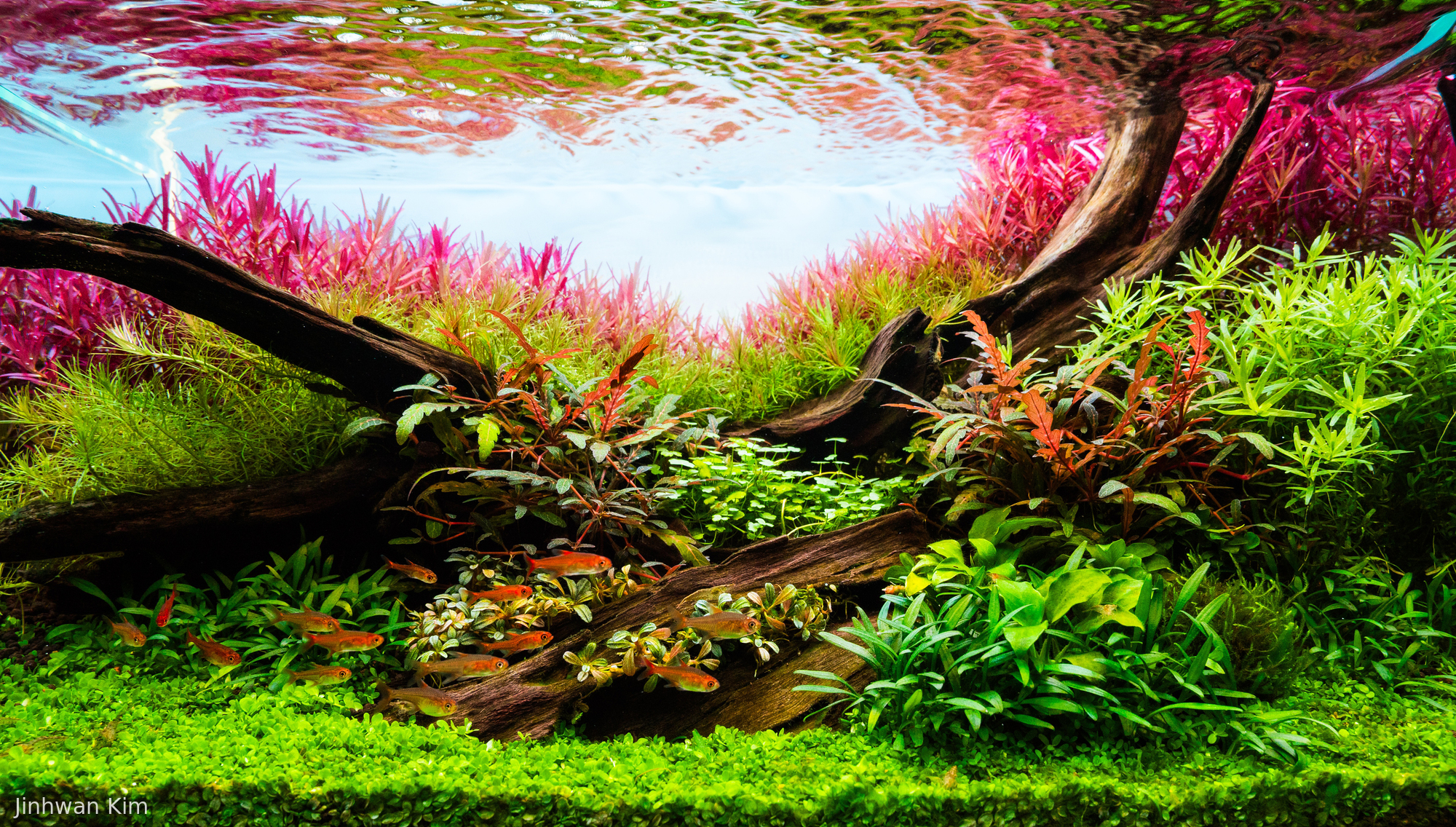
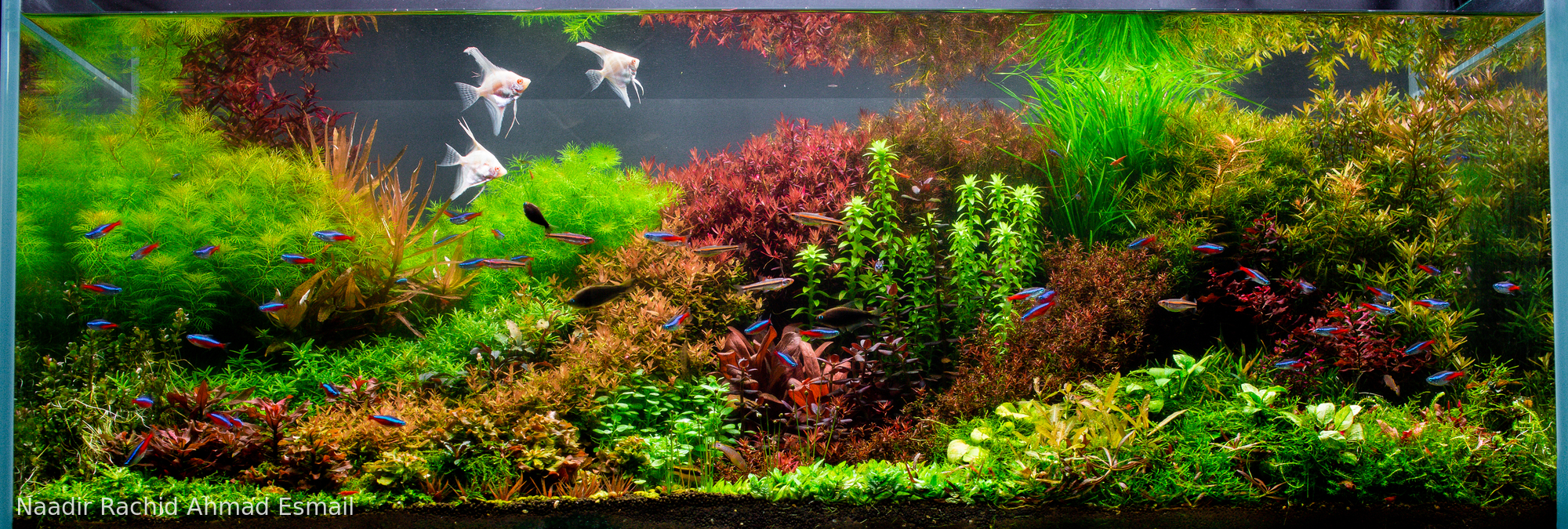
Some Classic Examples
These examples show a scale without forced perspective, where the composition appears as it would if viewed in person while snorkeling in a river and the plants are more prominent. There is a wide variety of species and the health and vigor are clearly displayed.
Biotope
A biotope is a habitat originating from a specific location. It has particular environmental characteristics specific to the area and a native population of plants and animals. A single stream or lake may include numerous biotopes. For instance, a stony riffle in a stream may be one biotope while a nearby silt-bottomed stillwater pool in the same stream may be a different biotope. The same biotope may also occur in numerous streams in a region where all stony riffles or silt-bottomed pools support the same community of plants and animals.
In its purest form, the biotope composition is a representation of a naturally-occurring particular geographical area in the wild.
A composition that accurately represents a biotope through species selection and arrangement of hardscape and living elements will receive a higher score.
Biotope Pre-selection Requirements
- Material used (including wood, rocks, and other hardscape) should, as closely as possible, represent the appearance of natural materials found in the specific location. Example: Mopani driftwood would not be used in an Asian rainforest biotope composition. However, manzanita wood could be used effectively to represent branches and roots in an Amazon biotope.
- Plants and animals should be indigenous to the specific location. Example: Poecilia reticulata (Guppy) should not be used in a Lake Malawi biotope composition.
- Choice and placement of plant and animal species should also represent the specific location. Example: Although found throughout river systems in Africa, Anubias congensis would not be appropriate for a Lake Tanganyikan biotope as it is not found in the lake itself.
- Exotic, non-native, or invasive species of plants and fish should not be used in a biotope composition. All flora and fauna should be native species originally indigenous to the biotope being described.
- Aquascaping principles used for other styles of layout are not necessarily applicable to biotope aquascaping. Focus should be directed toward creating an authentic replication of a natural habitat. Arrangement of hardscape materials, as well as placement and grouping of plants, should mimic what is authentically found in nature rather than an abstracted image of a natural scene.
- Salt marsh/marine planted aquaria are acceptable in the Biotope Category only. Plants/macroalgae should be the majority plant. Corals and other sessile inverts, if any, should be minimal.
- We do not condone the use of flora, fauna or materials that are collected from protected environments. If we find that an entrant has done this, their composition will be disqualified.
An expert committee will pre-screen submissions in the Biotope Category and accept those compositions that, in its sole determination, follow these rules. The committee’s determination will be final. If there are questions regarding the validity of the biotope composition, the committee may ask the competitor for justification.
Based on the criteria, to aid the screening process, we strongly suggest that the competitor provide the following additional information on the entry form:
- A description of the biotope represented by the composition.
- A description of the materials used in the composition, including plants, fish, invertebrates, and hardscape materials. Include why certain choices were made.
- References to substantiate the appropriateness of the materials used. Books, articles, photos, and web links are all acceptable references.
If the committee rejects a submission because it does not meet the Biotope guidelines, the AGAIAC will automatically disqualify the composition.
Biotope Judging Criteria
After a Biotope composition has been approved by the screening committee, it will be judged by the AGA International Aquascaping Contest judging panel. Each judge will score the biotope based on the following criteria:
1. General impressions (maximum 70 points)
- Is the composition a faithful representation of biotope?
2. Accuracy of plants and animals for biotope (maximum 60 points)
3. Accuracy of hardscape (maximum 40 points)
- Are materials used reasonable substitutions to represent the appearance of materials found in the specific location being recreated?
4. Condition (maximum 30 points)
- Has maintenance been performed to ensure habitat is healthy and properly managed? Are there excessive areas of detritus or obvious signs of neglect that are beyond what could be expected in a natural environment?
Dutch
Vin Kutty has written a quick style guide for beginners that will help clarify what is (and is not) Dutch Style. Our guidelines are heavily influenced by the Nederlandse Bond Aqua Terra (Dutch Society for Aquarists) or NBAT, the original style guideline formulated in the 1930s.
Dutch Judging Criteria
1. Overall Impression (maximum 50 points)
- Does the aquarium as a whole (plants, inhabitants, and hardscape) create a positive visual impact?
- Do all parts of the aquarium work together to present a harmonious and cohesive whole?
- Do the plants and inhabitants appear healthy?
- No hardware should be visible.
2. Composition: Balance, Use of Space, Use of Color (maximum 60 points)
- Is there effective use of the “Rule of Thirds” to create focal points? (Tanks 36” or less in length should not have more than one focal point.)
- Are the plants well grouped, and are the groups well defined? (Traditional NBAT rules dictate a small space between groups)
- Is there good use of differences in color, leaf size and shape, and height (growth habit or trimming) to maximize contrast between groups of plants? (Groups of neighboring plants should clearly be of different heights)
- Is there effective use of differences in height and plant group shape to create a sense of flow and depth? Do the species chosen and planting arrangement enhance or detract from the sense of depth and scale?
- Is there a plant “street”? If so, is it easily discerned and does it enhance the sense of depth of the composition?
- Are the back and sides planted? (Traditional NBAT rules dictate that the side and back walls either be covered by plants attached to the glass or be obscured by plants grown in the substrate. If planted walls are not present or if glass is visible, points should be deducted.)
3. Selection & Use of Plants, Hardscape Materials, and Inhabitants (maximum 50 points)
- Are the plants selected appropriate?
- Traditional NBAT rules dictate use of no more than 1 plant species per 10 cm/4 inches of tank length (sometimes up to 2 more species per tank if their use doesn’t detract from the composition; judge’s discretion). Is there an appropriately limited number of species?
- If a Specimen Plant is used as a focal point, does it blend well with the composition or is it overpowering? (i.e., does it draw and hold the eye too strongly or is it simply too large?)
- Do the colors, shape, and size of the inhabitants chosen harmonize with the plants?
- Are schooling fish present in sufficient numbers to make a suitable school? (Traditional NBAT rules dictate at least 12 fish per schooling species)
- If hardscape materials are present, are they used sparingly as a stand alone element? (A single piece of wood or stone may be acceptable according to NBAT rules if it enhances the composition. Wood and/or rocks used as structure and mostly covered by epiphytes does not count.)
- Are planted sides and rear panes present or absent? There should be no visible glass except for the front viewing pane. (This criteria only addresses the presence/absence of planted walls as a hardscape/design element for clarity. Use of walls should be considered as part of Composition.)
4. Viability of Composition (maximum 40 points)
- With appropriate grooming and maintenance, are the plants selected suitable for use in the aquarium if maintained as-is for a long period?
- If visible, are the fish and other animals likely to be too large for the aquarium, cause damage to the composition, or each other at adult size?
Paludarium
Criteria required for consideration as a Paludarium
- Aquatic portion of the composition must have a fully developed planted section. Submitting an additional image showing the hardscape prior to planting is highly encouraged.
- If inhabitants are included, they should be appropriate for the composition, and the water portion should be suitable to maintain long-term health.
- The entire composition must be fully or partially enclosed by glass, as opposed to a Riparium, which must only be enclosed on the bottom.
- The aquatic portion of a Paludarium, if developed, must only include aquatic plants and should not appear to be in emersed form, which would suggest recent submersion.
Paludarium Judging Criteria
Overall Impression (maximum 50 points)
- Does the composition make a significant positive visual impression upon the viewer?
- Do all parts of the composition work together to present a harmonious whole?
Proper Construction (maximum 70 points)
- Is a significant amount of the display devoted to water and is it a well developed and well planted part of the composition as a whole? This does not need to be 50/50 or even 25/75, as different tank sizes and shapes will dictate different ratios. But neither the land nor the water should be treated as a superficial “add on” or “feature”. Both must be well developed and well planted as part of the comprehensive composition. (maximum 30 points)
- Is a significant amount of the display devoted to land and is it well developed and well planted part of the whole design? This does not need to be 50/50 or even 25/75, as different tank sizes and shapes will dictate different ratios. But neither the land nor the water should be treated as a superficial “add on” or “feature”. Both must be a well developed and well planted part of the whole design. (maximum 30 points)
- Is the entire paludarium cohesively designed; i.e. does the land flow naturally into the water? (maximum 10 points)
Composition, Balance, Use of Space and Color, Selection and Use of Materials (maximum 50 points)
- Does balance exist between the various components of the composition? Is space within the aquarium used effectively? Do open areas exist and do they balance and complement more enclosed spaces?
- Are the colors of the various elements of the paludarium (including animals) complementary to the composition overall?
- Are the materials selected for use within the composition appropriate for use in a paludarium? While it is common to use artificial materials when building a paludarium, are they well-hidden so as not to distract from the display?
- Are the various materials harmonious with one another? For example, if several rocks and/or pieces of driftwood are used, do they complement one another or do they produce a discordant effect?
- Do the inhabitants complement or detract from the selection and arrangement of hardscape and plants? Including inhabitants is optional, though the addition of appropriate species can serve to enhance the overall composition.
Viability of the Paludarium (maximum 30 points)
- Are the plants selected appropriate for long term use in the land or water portion as they are used? Are the plants chosen likely to over-run the enclosure, or will inhabitants be too large or otherwise incompatible with the living area at their adult size?
- Are the inhabitants likely to cause damage to one another or to the Paludarium itself? Are the inhabitants appropriate to the size of the space they are provided?
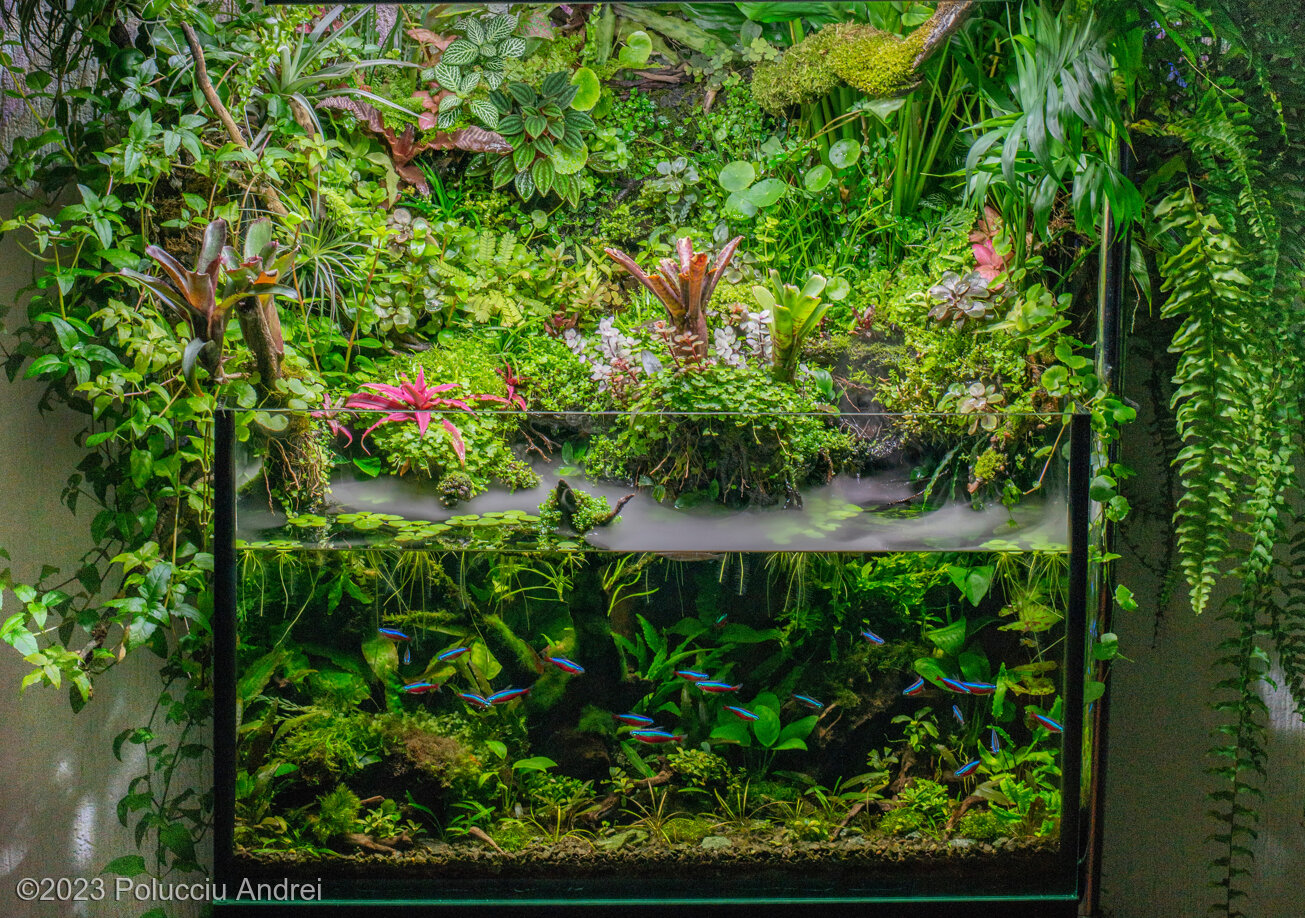
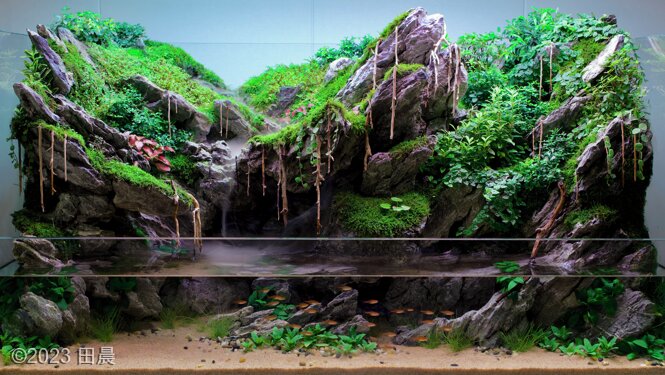
Some Paludarium Examples
Note how the paludariums shown are fully or mostly enclosed, and the terrestrial as well as aquatic sections are well developed.
Wabi-Kusa
For the purposes of this contest, a Wabi Kusa is a ball of compressed substrate that has been developed into an artistic interpretation of aquatic plants that are not contained by their vessel, but by planting onto a substrate ball from where they can freely grow.
- A photo clearly showing the Wabi Kusa substrate ball must be included for the composition to be considered valid in the category.
- A photo showing the water portion must be included for the composition to be considered valid in the category.
- The Wabi Kusa must not include any terrestrial plants. All plants used must be aquatic plants that can be normally grown submersed and used in an aquarium. Use of marginal pond plants or terrarium/vivarium plants is not allowed, and will result in immediate disqualification of the entry.
Wabi Kusa Judging Criteria
Health and Condition (maximum 100 points)
- Is the layout healthy and free from any signs of pests or disease? (maximum 40 points)
- Are the aquatic plants healthy and appropriate for the composition? Terrestrial plants are not permitted. (maximum 40 points)
- Is the water portion clean and clear? Layouts without a water element will be disqualified. (maximum 20 points)
Artistic Skill, Impression, and Creativity (maximum 100 points)
- Does the layout demonstrate artistic skill through the use of arrangement, colors, textures, and hardscape? (maximum 40 points)
- Is the layout particularly creative or impactful? (maximum 40 points)
- Do any other elements of the Wabi Kusa (such as the vessel and light chosen for display, etc.) add to or detract from the impression? (maximum 20 points)
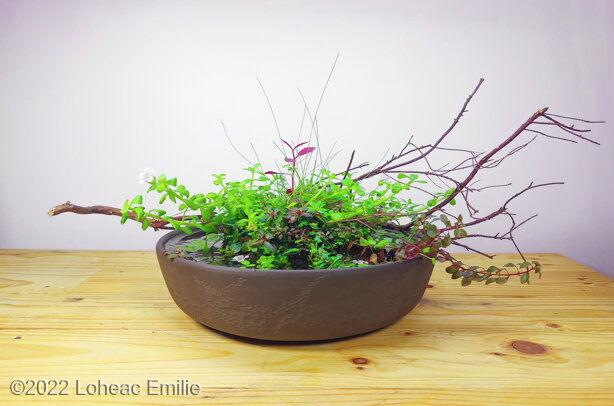
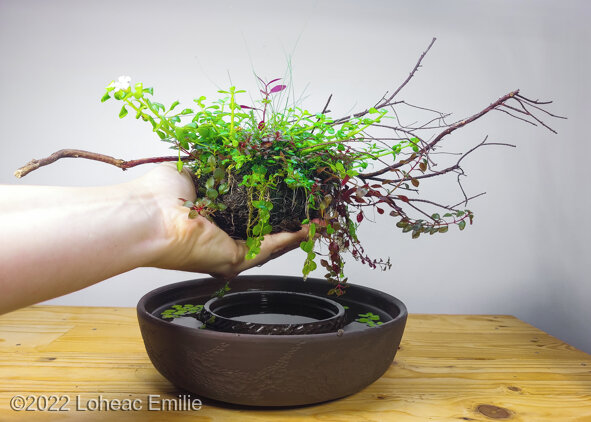
Wabi Kusa Example
Note the supplemental photo showing the required substrate ball.
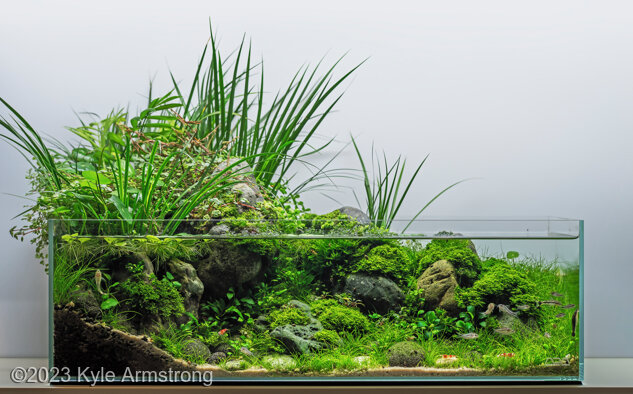
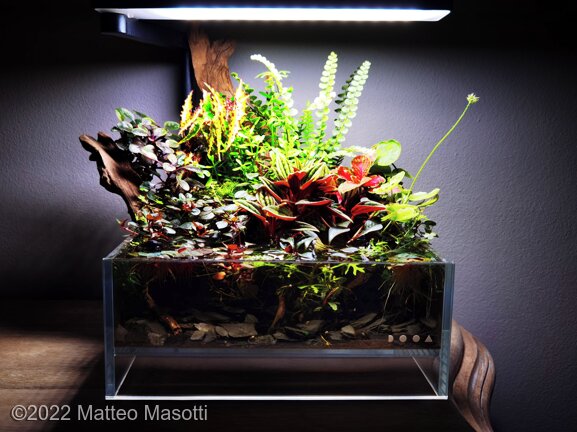
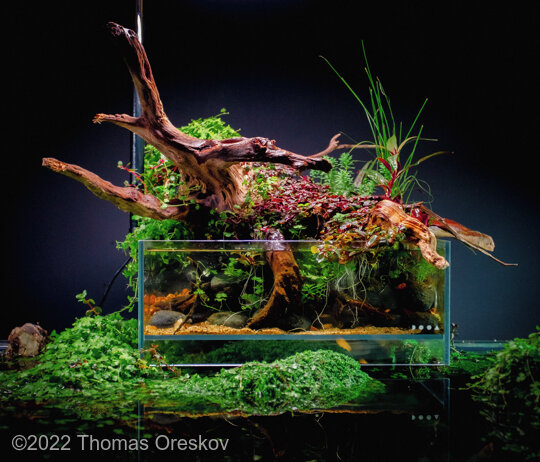
Riparium
A Riparium is described as a riverbank or shoreline depiction, where the containment requirement only includes the lower aquatic section. A Riparium allows for the use of both aquatic and terrestrial plants, but does not require a well developed aquatic section, as is necessary for a Paludarium. Because of the uniqueness of this type of composition, and lack of requirement to have a well developed aquatic section, use of fauna is not required and may be penalized if the environment is not suitable for proper husbandry.
The aquatic portion of a Riparium, if developed, must only include aquatic plants and should not appear to be in emersed form, which would suggest recent submersion.
Riparium Judging Criteria
Overall Impression (maximum 50 points)
- Does the composition make a significant positive visual impression upon the viewer?
- Do all parts of the composition work together to present a harmonious whole?
Terrestrial Section (maximum 45 points)
- Plants can be terrestrial, epiphytic and/or the emersed form of aquatic plants, but preference should be for compositions including the use of some aquatic plants.
- Is the terrestrial section well developed with the use of hardscape and plants?
Aquatic Section (maximum 25 points)
- Is the hardscape below the water integrated with that above the water?
- Is the water section used as an attractive addition to the display or is it overlooked as part of the overall composition?
- Are aquatic plants included in the water section? (while not a requirement, use is encouraged and should be rewarded)
Composition, Balance, Use of Space and Color, Selection and Use of Materials (maximum 50 points)
- Does balance exist between the various components of the composition? Is space within the display used effectively?
- Are the colors of the various elements (including inhabitants, if present) complementary and do they work well together?
- While it is common to use artificial materials when constructing a Riparium, are they well-hidden so as not to distract from the display?
- Are the various materials harmonious with one another? For example, if several rocks and/or pieces of driftwood are used, are they complementary?
- Do the animals (if present) complement or detract from the selection and arrangement of hardscape and plants?
- Is terrestrial planting well developed? If used, plants grown in the aquatic portion should be appropriate and in fully submersed state.
Viability of the Riparium (maximum 30 points)
- Are the plants selected appropriate for long term use in the land or water portion as they are used? Are the plants chosen likely to over-run the enclosure, or will inhabitants be too large or otherwise incompatible with the living area at their adult size?
- Are the inhabitants likely to cause damage to one another or to the Riparium itself? Are the inhabitants appropriate to the size of the space they are provided?
Some Riparium Examples
Note the visible presence of water in a vessel that does not enclose the entire composition.
Questions?
If you have a specific question not addressed here in this guide, feel free to contact [email protected].