#1435 Morning Java


- Filter
- Oase Biomaster 600 powered by an Oase Optimax 1420 pump. Aquatop SSK-65 surface skimmer runs 24/7. Coospider UV filter runs 3 hours nightly and after tank maintenance.
- CO2 System
- About 45 ppm CO2, beginning 3 hours before lights on and ending 1 hour before lights off. Yugang horizontal reactor.
- Lighting
- Week Aqua P1200 Pro, 100 par at substrate, 8 hours daily
- Substrate
- Mojave Controsand capped with AquaNatural Prairie Sand, and a packet of Amazonia 2 under the Nymphae zenkeri.
- Hardscape Materials
- None
- Background
- Black vinyl film on the outside. Bucephalandra Melawi Red on inner back on black mesh. Pilo moss on inner sides on black mesh.
Species
15 Pseudomugil luminatus 12 Marosatherina ladigesi 15 Corydorus venezuelanus 6 Crossochelius siamensis (juvenile)
Plant species
1. Bacopa caroliniana 2. Aponogeton boivianus 3. Hygrophila corymbosa 'Cherry leaf' 4. Acmella repens 5. Nymphae zenkeri 6. Cardamine lyrata 7. Limnophila aromatica mini 8. Microsorum pteropus 'Narrow K' 9. Heteranthera zosterifolia 10. Echinodorus 'Red pearl' 11. Helanthium bolivianum Angustifolia 12. Penthorum sedoides 13. Shinnersia rivularis 14. Nymphoides hydrophylla 'Taiwan' Sides: Pilotrichaceae sp. moss Back: Bucephalandra Melawi Red
Fertilization
Burr Aqua ferts dosed 6 ml/daily, 15 ml after a weekly 50% water change, and 1 ml after two 15% weekly water changes. Total: 20/5/23 macros, .56 Fe as proxy micros.
Tracy Ruhlman
Colorado Springs, CO, United States
Quick Stats
- Style
- Dutch
- Size
- 120x50x45 cm
- Volume
- 270 L (71.3 gal.)
- Plant Species
- 16
- Fish Species
- 4
Judges' Comments
This aquarium, measuring 120x50x45 cm (270.0 L), appears fresh, healthy, and attractive at first glance. The two striking specimen plants are real eye-catchers, positioned neatly at the 1/3 and 2/3 marks within the tank. The plant groups are well-spaced from one another. However, the red lotus is arguably a bit too tall, obstructing the view of the *Bucephalandra* 'Melawi Red'—which, situated behind it, helps create a sense of dark depth against the back wall. *Microsorum pteropus* 'Narrow K' covers a large portion of the center of the back wall; creating a gap in this foliage—either on the left or the right—could enhance the sense of depth. As it stands, the entire back wall is obscured by continuous planting. *Aponogeton boivianus* grows too large for its current location, and its leaves partially overlap the *Hygrophila corymbosa* 'Cherry Leaf', giving the left side of the aquarium a somewhat cluttered appearance. The selection of fish is very appealing, and they have ample living space in this aquarium. As with other entries, the underexposed photograph does not do the aquarium justice.
— Bart Laurens
It takes an extra high level skill set to achieve good separation and depth like this, with clearly defined groups, when using so many plants of similar color. This tank does it with mostly greens, a couple of non-stand-out colors and only two bold reds - thats just like the founders intended. This tank would feel right at home on mid-century Leiden Street in The Netherlands Color requirements have relaxed a little bit today (at least here) to where its ok to have more than a couple bold ones, as long as you dont over do it. Colors do a lot of the work automatically, which can fool a person into thinking they know more than they do. Its not hard to show clear separation with a bowl of skittles. Try it with lima beans and youll see where your understanding stops. Here those dark shadowy areas where groups are about to meet create a good sense of separation and depth. Those areas didnt just happen, they were created on purpose by precisely controlling the heights of each group. A prime example is where Heteranthera runs into the Narrow K. If Hetanthera was 2-3 inches taller, that shadow would disappear and take all sense of depth and separation with it. Visually those two plants would merge together as one big green shape The whole foreground borders on perfection. Ideal plant choice and placement. Its always good to leave ample empty space along the front and between the foreground groups. This tank takes it a step further turning the space between each group into subtle little pathways leading to the back that the eyes cant help but follow. The light colored substrate is perfect for this tank and the contrast is used to its full advantage The sword and Lily are both prime looking specimens. They're in the exact right spots for focal points, alternated like double focal points should be, one in the lower front quadrant, one in the upper rear quadrant. Whats really impressive is the restraint it must've taken not to pull a few of those bottom sword leafs off (lol) I would not have been able to resist. That dark block of color needs to extend all the way to the ground just like it is. Pulling those leaves off wouldve changed the whole color dynamic Hygro Cherry in the back left doesn't bring much to the table. Its not hurting anything just cant see it much, at least in the main pic. Absolutely love the Narrow K across the back. My only critique is the top of it being such a straight line all the way across where its meeting the waters surface. If you couldve dropped just a piece or two down a couple inches it wouldnt be such a rigid straight line. Its not a huge deal. The Buces on each end look real nice Acmella repens is always a great street plant and that a good place for it. I can see you tried to use smaller ones in the very front. Thats the right idea any when you plug and play short tops of a larger size stem in the very foreground. Its a good street now but wouldve hit its prime with another week or two but another week or two the street would really hit its prime This is a beautiful Dutch and it comes with a deceptively high level of difficulty. Very impressive, I love this tank!
— joe harvey
Gotta love this tank! Plants are all in great health. Stunning focal point with Nymphaea. Foreground is well-executed. Feels overgrown, especially in the back left. The primary photo feels dark, but the supplemental photos show the tank in its real beauty. I suggest using external spotlights in front to illuminate the dark corners. Jave fern in the back is overgrown and that’s caused a loss of feeling of depth. Aponogeton boivinianus is an enormous plant that feels stuffed back there somewhere. Cherry leaf needs aggressive trimming. Slow-growing Acmella is a tempting candidate for a street, but it rarely works – it’s best used as in midground. Reduced contrast between plant groups robs the tank of a feeling of depth.
— Vin Kutty
Come Grow with The Aquatic Gardeners Association.
Since 1985 the Aquatic Gardeners Association has been the standalone organization focused on promoting aquatic plants, education, aquascaping, and fostering the community of planted aquarium enthusiasts.
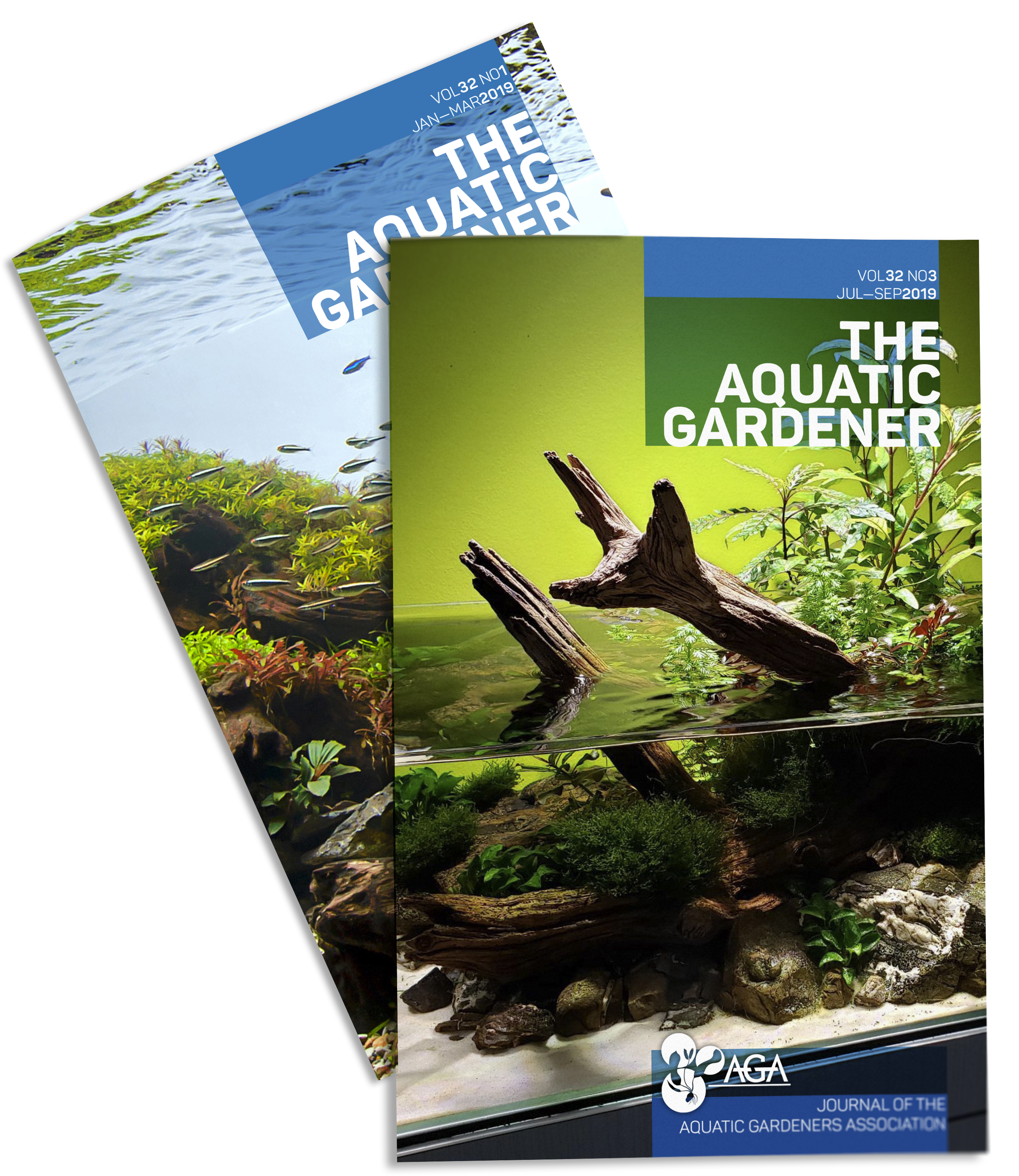
The Aquatic Gardener Magazine
Membership has its privileges—such as a subscription to the award-winning quarterly journal The Aquatic Gardener, available in both print and digital formats, access to the digital archive of all published issues as well as video from our convention speakers dating back 25 years. With more exciting projects on the horizon you’ll be part of a unique community of aquatic plant and aquascaping fans eager to expand our side of the aquarium hobby.
Our 2026 Sponsors
Premier Sponsor

Executive Sponsors





Associate Sponsors


Club Sponsors