#1421 Lion’s Cove
Lion’s Cove, Zambezi River Drainage Basin, Lake Malawi, Republic of Malawi


About This Aquascape
The 200-liter aquarium was inspired by Lion's Cove, located on the central west coast of Lake Malawi—a biotope highly representative of the Mbuna ("rock-dwelling fish") group. Given its dimensions, the tank was designed to house only one species: in this case, one male and two females of *Pseudotropheus* sp. 'polit', a relatively small but quite temperamental Mbuna. Taking advantage of the tank's height (70 cm), I arranged the rocks and side background to create an impression of verticality and depth, characteristic of the area being represented. I keep the lighting on for 10 hours a day at medium-to-high intensity to stimulate biofilm growth on the rocks as a food source for the fish—mimicking conditions in the actual region, where sunlight penetration in shallow and intermediate zones fosters the development of *aufwuchs*, a biological mat of algae and microorganisms. This biofilm forms the base of the food chain and drives the strong territorial behavior of the local herbivorous fish. Maintenance involves 25% water changes every two weeks and the use of a buffer to adjust and maintain water parameters.
- Filter
- For filtration, I use a 900 l / h Jebo container, using only a biological blanket for mechanical filtration and 2 liters of Oceantech ceramic for biological filtration.
- Lighting
- I use an Oceantech Noir LED fixture that simulates sunrise and sunset. Despite the sunlight incidence, due to the region's greater depth, the water exhibits a bluer tint from the penetration of blue light—which is why a bar of blue LEDs was installed alongside the main fixture to simulate this effect.
- Substrate
- River sand.
- Hardscape Materials
- The decoration is basically composed of rocks granite—in gray and some reddish and beige tones—aiming to resemble what we see in underwater images of the Lion's Cove region.
- Background
- Two large artificial rocks were blended with smaller ones, along with a side background, arranged to try to recreate an environment similar to that region on the central west coast of Lake Malawi. In the rear window, I used a blue vinyl panel to promote the feeling of infinity.
Species
Pseudotropheus polit (Konings, 1990)
Plant species
The biotope represented is a purely rocky environment; therefore, there are no plants in the aquarium.
Biotope Information
Lion's Cove, located on the central-west coast of Lake Malawi, represents an ecosystem of immense ecological significance. This habitat serves as an isolated center of speciation and evolution, harboring various endemic geographic variants of African cichlids. Local biological dynamics are inextricably linked to the complexity of its underwater rock formations. The environment is notable for its sheer vertical rock faces that descend from the slopes and extend toward the lakebed, forming an architecture of rocky crevices. Its sheer vertical granite walls and the near-total absence of organic sediment on the exposed rock—a result of continuous coastal currents. Sunlight penetration in the shallow and intermediate zones supports the growth of *aufwuchs*, a biological mat of algae and microorganisms. This biofilm forms the foundation of the food web and drives the strong territorial behavior of local herbivorous fish. This biotope is highly representative of the Mbuna group ("rock-dwelling fish"), perfectly illustrating niche specialization in East Africa. Studying Lion's Cove provides insight into how physical factors—such as depth and the architecture of rock crevices—regulate social behavior, sexual dimorphism, and the cryptic survival mechanisms of species like *Pseudotropheus polit*. - Environment Environment type: Deep coastal rocky habitat, characterized by narrow three-dimensional vertical cracks and caves formed by ancient geological landslides. Riparian zone: Abrupt coastal margin made up of rocky outcrops and stone cliffs that plunge directly into the water, without transition beaches. Terrestrial vegetation: Sparse shrubby savannah vegetation and small trees adapted to arid/rocky soils on top of coastal escarpments. Features of the surrounding area/landscape: Rugged mountains and hills surrounding the central portion of the lake, with low human population density on the immediate shoreline. Underwater landscape: Monumental architecture of overlapping granite blocks, creating labyrinths of dark tunnels. External surfaces covered with a brownish-green biofilm and complete absence of higher plants or trunks. - Water Properties Water type: Crystal-clear / Mineralized alkaline water Water color: Colorless / Bluish at depth Water transparency: Extremely high (horizontal visibility often exceeding 20 meters) Sediment concentration: Nil / Very low (absence of suspended particles due to currents) Water temperature: 23°C to 28°C (Average of 24°C to 26°C in zones inhabited by *P. polit*) Water flow/current type: Constant surface waves and moderate coastal currents with variable direction. - Chemical Parameters pH: 7.8 – 8.5 Conductivity: 210 – 285 µS/cm (Standard average of 241 µS/cm at 25°C) GH (General Hardness): 4° – 6° dH KH (Carbonate Hardness): 6° – 8° dH Oxygen: High saturation (oxygenation close to 100% in the upper layers due to wave action). - Ecological threats Localized overfishing pressure driven by the international aquarium trade (selective capture of rare morphs) and potential future risks of sedimentation should deforestation occur on nearby land slopes. - Bibliography KONINGS, Ad. Malawi Cichlids in their Natural Habitat. 4. ed. El Paso, Texas: Cichlid Press, 2007. 424 p. KONINGS, Ad. The Cichlid Diversity of Lake Malawi: Results of 30 Years of Field Research. Overpelt: Cichlid Press, 2016. SNOEKS, Jos (ed.). The cichlid diversity of Lake Malawi/Nyasa/Niassa: identification, distribution and taxonomy. El Paso, Texas: Cichlid Press, 2004. - Webography BIOTOPE AQUARIUM PROJECT (BAP). Lake Malawi: Lion's Cove Biotope Profile. Experts Section: Ad Konings. Available at: https://biotopeaquariumproject.com. Accessed on: July 11, 2026. FRICKE, Ronald; ESCHMEYER, William N.; VAN DER LAAN, Richard (eds.). Eschmeyer's Catalog of Fishes: Genera, Species, References. San Francisco: California Academy of Sciences, 2026. Available at: calacademy.org. Accessed on: July 11, 2026. FROESE, Rainer; PAULY, Daniel (eds.). FishBase. World Wide Web electronic publication, v. 2026. Available at: fishbase.org. Accessed on: July 11, 2026. MALAWI.SI. Lake Malawi Water Chemistry and Physics. Maribor, Slovenia, 2026. Available at: malawi.si. Accessed on: July 11, 2026.
Quick Stats
- Style
- Biotope
- Size
- 60x50x70 cm
- Volume
- 210 L (55.5 gal.)
- Plant Species
- 2
- Fish Species
- 2
Judges' Comments
A generously sized, well-researched habitat with highly accurate hardscape and a convincing environment for the fish. The principal weakness for me is the visibility of the aquarium’s boundaries, which reminds the viewer of the display’s confines rather than creating the impression of a continuous natural habitat.
— Tai Strietman
Lions Cove was one of the first biotopes in Lake Malawi that I learned about, and I believe many hobbyists become familiar with this habitat through the iconic Yellow Lab cichlid. I appreciate the use of granite rock in this aquascape, as it helps represent the natural geological features of the habitat. However, I would have liked to see the aquarium mature further before entering, allowing more time for biofilms to develop and contribute to a more natural appearance. I also think the dimensions of the aquarium present some challenges in creating a greater sense of depth within the scape.
— Kapil Mandrekar
An interesting interpretation of Lake Malawi's rocky habitat! I appreciate the unusual tank dimensions, particularly the height, which helps recreate the steep underwater rock formations of Lion's Cove.
— Rodrigo Silva
Come Grow with The Aquatic Gardeners Association.
Since 1985 the Aquatic Gardeners Association has been the standalone organization focused on promoting aquatic plants, education, aquascaping, and fostering the community of planted aquarium enthusiasts.
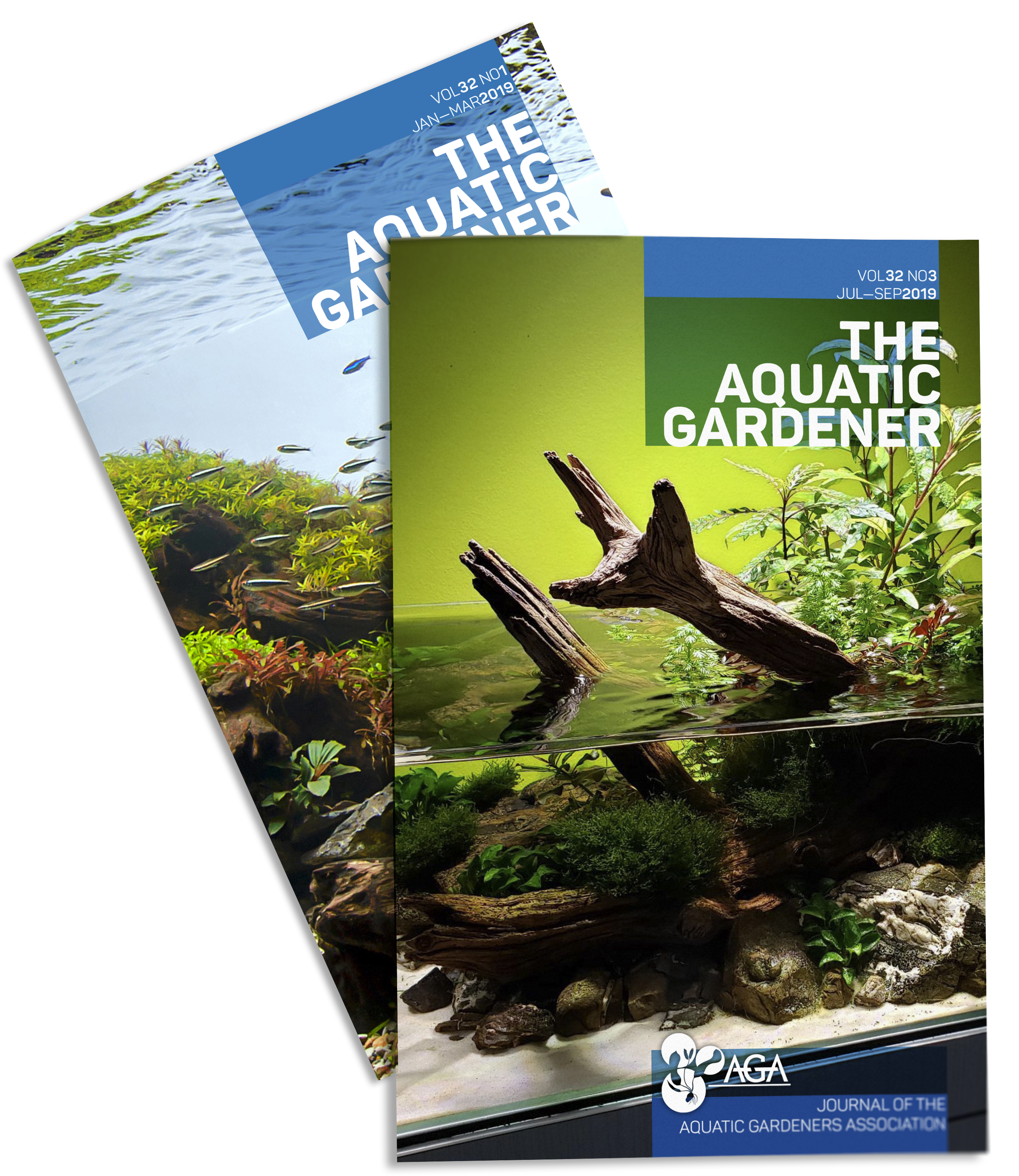
The Aquatic Gardener Magazine
Membership has its privileges—such as a subscription to the award-winning quarterly journal The Aquatic Gardener, available in both print and digital formats, access to the digital archive of all published issues as well as video from our convention speakers dating back 25 years. With more exciting projects on the horizon you’ll be part of a unique community of aquatic plant and aquascaping fans eager to expand our side of the aquarium hobby.
Our 2026 Sponsors
Premier Sponsor

Executive Sponsors





Associate Sponsors


Club Sponsors