#1361 Kalimas
Kalimas,Grabag,indonesia


- Filter
- Sump filter 60x40x30cm mechanical and biological filter media. And pump with 2000 LPH flow rate.
- CO2 System
- No co²
- Lighting
- Kandila S series WRGB 50cm 25watt and yellow spotlight as sunlight effect.
- Substrate
- The substrate consists of three layers. The first layer is soft brown sand, the second layer is dried mud which is then finely sieved, and the topmost layer is a thin layer of wet mud as a sediment to resemble the natural habitat.
- Hardscape Materials
- Driftwood,Bamboo twigs/Small bamboo branches
- Background
- White vinyl
Species
Betta picta, Caridina sp, Anentome helena
Plant species
Marsilea crenata
Fertilization
Water changes are performed once a week to maintain water quality, with the addition of bacteria starter, and replacement of decayed leaves.
Biotope Information
This biotope aquarium focuses on the wild Betta picta. This biotope replicates a shallow swamp in a paddy field area fed by a small spring from Tuk Mas / Kali Mas. This area was formerly a small natural swamp. Now it has become a Mendong paddy field (Fimbristylis umbellaris (Lam.) Vahl), but a small flow of water remains due to a spring inside the paddy. Water depth is 5-15 cm, slow flowing, clear with a brownish tint. The substrate is blackish-brown mud with thick leaf litter and roots of Fimbristylis umbellaris. Many plants live on the water surface, including Water Lettuce (Pistia stratiotes L.) as a hiding place, Water Clover (Marsilea crenata C.Presl), Water Hyacinth (Pontederia crassipes Mart. syn. Eichhornia crassipes (Mart.) Solms) and others. Betta picta is now very rare due to excessive pesticide use and land conversion. This spring-fed paddy swamp is their last refuge. Fauna found in this habitat: • Betta picta (Spotted Betta) • Channa limbata (Mountain Snakehead) • Nemacheilus fasciatus (Banded Loach) - local name Uceng • Rasbora argyrotaenia (Silver Rasbora) - local name Wader • Rasbora lateristriata (Yellow Rasbora) - local name Lunjar • Caridina sp. (Dwarf Shrimp) • Parathelphusa convexa (Sawah Crab) • Pila scutata (Apple Snail) - large paddy snail • Anentome helena (Assassin Snail) syn. Clea helena • Sulcospira testudinaria - local name Sumpil https://youtu.be/BbWIBwbASdU?si=36cq_K0WNnIaKL5N https://drive.google.com/drive/folders/1boxduz5n0sto-qYyJFxAvAG07zd7bmU3
Quick Stats
- Style
- Biotope
- Size
- 65x40x31 cm
- Volume
- 80 L (21.1 gal.)
- Plant Species
- 1
- Fish Species
- 3
Biotope Location
Judges' Comments
This is a very good and thoughtfully executed attempt at recreating a natural biotope. The creator has constructed an exceptionally convincing bank using carefully selected substrates, twigs and vegetation, producing an authentic and organic representation of the habitat. I particularly appreciate the restrained approach to fish selection. Rather than attempting to include every species recorded from the location, the creator has chosen to focus on a single species while providing evidence of the wider fish community. This is a sensible approach that allows the display to remain focused and ecologically convincing. The internal composition is very natural and realistic. My main reservation is the treatment of the background, which feels rather flat and two-dimensional. The obvious termination of the habitat at the rear of the aquarium somewhat diminishes the illusion of looking into a continuous natural environment, reminding the viewer that this is a constructed display rather than a genuine cross-section of the habitat. Nevertheless, this is a very solid and impressive piece of work. I am particularly taken with the beautifully executed sloping mud bank along the left side of the aquarium. It is such a convincing feature that I would genuinely be interested to learn how the creator achieved it.
— Tai Strietman
This is a interesting biotope to the reconstruct. Not many look to work on a system that has such human influence. As simple has this scape is the hardscapes are well placed. I love how you had the silt build on the corner of the tank.
— Kapil Mandrekar
A lovely choice of fish, and I really appreciate the effort to raise awareness of this species and its threatened habitat! The tangled roots and vegetation on the left look incredibly natural, and I would have loved to see this approach developed further throughout the aquarium. The rest of the composition feels a little empty and could benefit from more complexity and depth. It would also be wonderful to see more of the other fauna found in this habitat represented. Overall, a thoughtful recreation with a great conservation message and plenty of potential!
— Rodrigo Silva
Come Grow with The Aquatic Gardeners Association.
Since 1985 the Aquatic Gardeners Association has been the standalone organization focused on promoting aquatic plants, education, aquascaping, and fostering the community of planted aquarium enthusiasts.
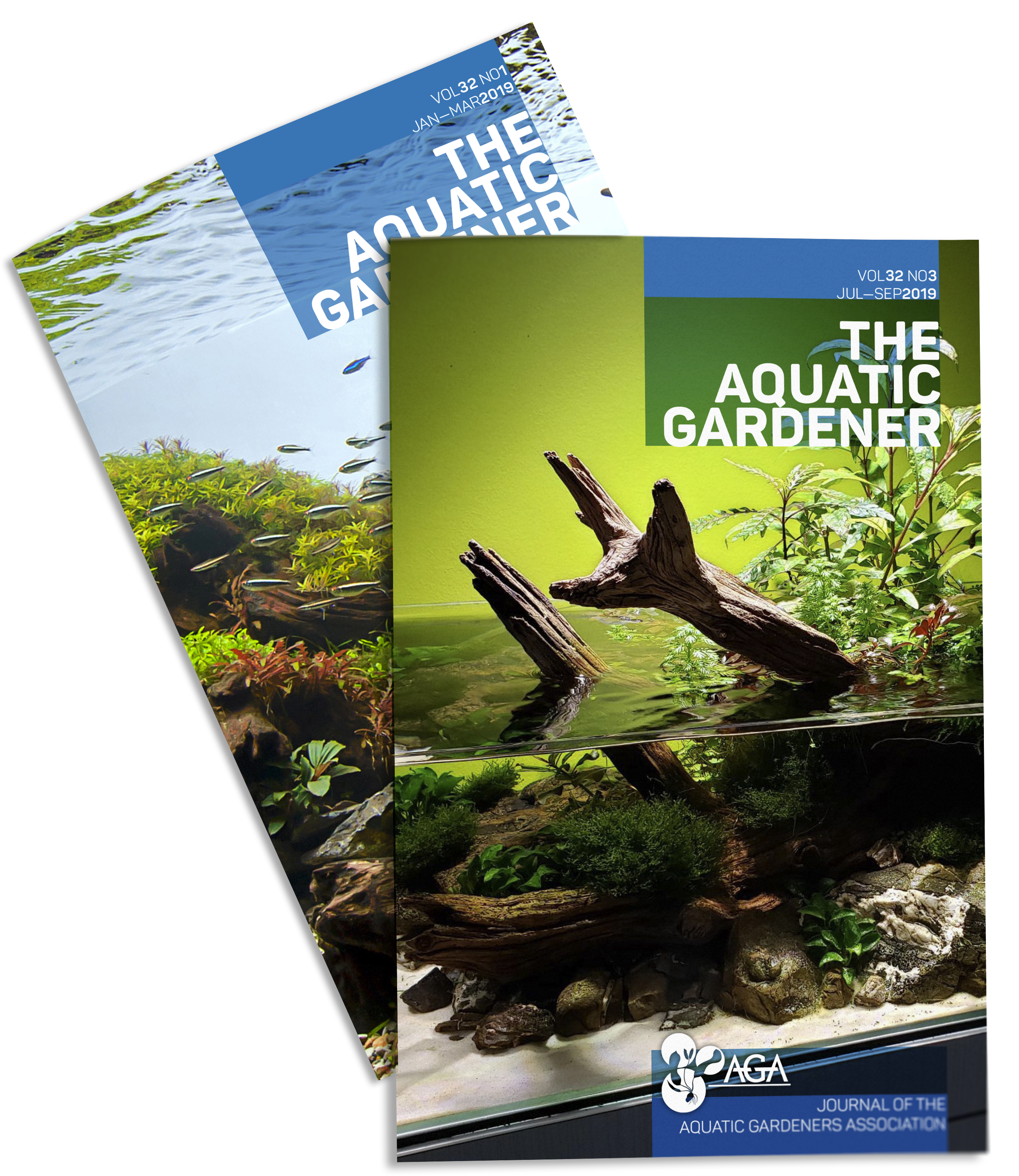
The Aquatic Gardener Magazine
Membership has its privileges—such as a subscription to the award-winning quarterly journal The Aquatic Gardener, available in both print and digital formats, access to the digital archive of all published issues as well as video from our convention speakers dating back 25 years. With more exciting projects on the horizon you’ll be part of a unique community of aquatic plant and aquascaping fans eager to expand our side of the aquarium hobby.
Our 2026 Sponsors
Premier Sponsor

Executive Sponsors





Associate Sponsors


Club Sponsors