This entry has been disqualified.
While this is a truly lovely biotope entry, unfortunately the livestock selection and representation are not completely accurate for the location stated. Please see comments from the judges for more detail.
#1309 Rosy Currents in a Crystal Ribbon
Rio Trombetas river basin, Pará state, Brazil. The Rio Trombetas basin is known as a turquoise ribbon hidden amidst the vast wilderness of Pará state, Brazil. Here, crystal-clear waters weave through fallen, weathered logs


About This Aquascape
The beauty of the Rio Trombetas is truly stunning, vibrant, and unique—standing out among the countless other rivers of South America. That is precisely why I wanted to showcase the beauty of the Rio Trombetas at this year's AGAIAC 2026. I hope the judges and everyone else enjoy it!
- Filter
- Sunsun XWA 1000-5 (24W - 1400L/H)
- CO2 System
- ~30 ppm CO2, running 1 hours before lights on and turning off 1 hours before lights out
- Lighting
- Week T90 Pro B3.0 (RGB 90W)
- Substrate
- CIBI base level (Product from Vietnam), JBL Tormec Activ 100ml. On the top are a mix of yellowish-white sand and finely crumbled guava leaves.
- Hardscape Materials
- The primary materials are driftwood, tree branches, and a mix of yellowish-white sand and finely crumbled guava leaves.
- Background
- None
Species
Dicrossus maculatus : x2 Hypoptopoma sp : x1 Otocinclus vittatus : x6 Hyphessobrycon rosaceus : x15
Plant species
Eleocharis acicularis Helanthium tenellum
Fertilization
Change the water every two weeks.
Biotope Information
Over a substrate of fine sand mingled with decaying leaf litter, scattered patches of Eleocharis and reddish Helanthium interweave, gently swaying to the rhythm of a mild current. Beneath the sunken driftwood canopies, a school of Rosy Tetras (Hyphessobrycon rosaceus) glides by with ethereal grace, strikingly highlighted by their tall dorsal fins that exhibit a bold black-and-white contrast. Down among the detritus, a pair of Dicrossus maculatus displays flawlessly symmetrical checkerboard patterns. Their rounded caudal fins shimmer with hints of red and blue—a stark contrast to the lyretail of their congener, D. filamentosus, which is typically found in blackwater rivers. As they weave through the Eleocharis shoots, they captivate biotope enthusiasts—not with flamboyant coloration, but with their undeniable wild charm and mesmerizing sand-sifting behaviors, meticulously picking through leaf fragments and gravel to forage and prepare nesting sites. Meanwhile, on the decaying, sunken branches, the tiny clinging mouths of Otocinclus tirelessly graze upon patches of algae and the rich biofilm of the rotting wood. All these elements harmonize seamlessly, presenting a truly authentic, living slice of majestic nature. Actual images captured in the wild: https://drive.google.com/drive/folders/1GZFQtGvaXliwn9hjju9h3Y8uNaVbf7dT?usp=sharing
Duc Nguyen
Ho Chi Minh city, Southeast Asia, Vietnam
Quick Stats
- Style
- Biotope
- Size
- 100x40x30 cm
- Volume
- 120 L (31.7 gal.)
- Plant Species
- 2
- Fish Species
- 4
Judges' Comments
An impressive, natural and organic composition with healthy cichlids, carefully chosen plants and an effective presentation of the rosy tetras. I find the habitat highly convincing overall. My only notable aesthetic reservation is the backlighting, which feels somewhat unnatural and detracts slightly from the impression of a genuine habitat.
— Tai Strietman
This aquarium is beautiful and makes a wonderful show piece however I do not think it accurately represents a Trombetas. Dicrossus maculatus, are from th Tapajos river and other connected tributaries. Hyphessobrycon rosaceus, are from Guyana, Suriname and northern parts of Brazil.
— Kapil Mandrekar
Finally, a Brazilian biotope that goes beyond a few branches and cardinal tetras! I love the incorporation of aquatic plants and the beautifully thought-out composition. Just because it's a biotope doesn't mean composition should be overlooked; a biotope display is still a form of art, and this one demonstrates that beautifully! The arrangement feels natural, immersive and visually striking. However, I do have some concerns about species accuracy, particularly Hyphessobrycon rosaceus, which is documented from the Guyana and Suriname river systems. I couldn't verify its occurrence in the Rio Trombetas basin. Nevertheless, a fantastic piece of work with a wonderful balance of creativity and naturalism!
— Rodrigo Silva
Come Grow with The Aquatic Gardeners Association.
Since 1985 the Aquatic Gardeners Association has been the standalone organization focused on promoting aquatic plants, education, aquascaping, and fostering the community of planted aquarium enthusiasts.
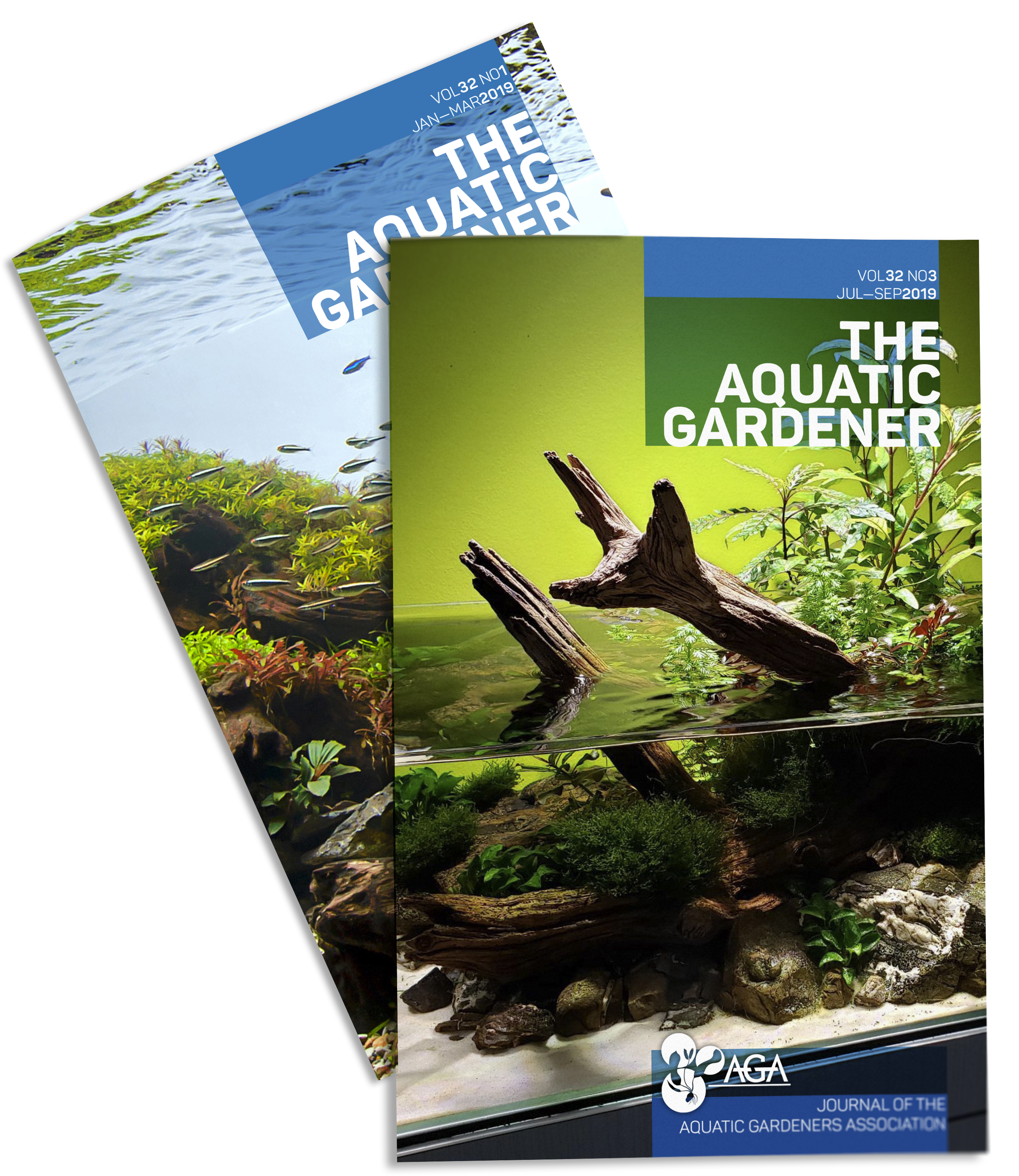
The Aquatic Gardener Magazine
Membership has its privileges—such as a subscription to the award-winning quarterly journal The Aquatic Gardener, available in both print and digital formats, access to the digital archive of all published issues as well as video from our convention speakers dating back 25 years. With more exciting projects on the horizon you’ll be part of a unique community of aquatic plant and aquascaping fans eager to expand our side of the aquarium hobby.
Our 2026 Sponsors
Premier Sponsor

Executive Sponsors





Associate Sponsors


Club Sponsors