#1222 Sweat Equity


About This Aquascape
This tank was my first true attempt at creating a Dutch aquarium. I tried to follow the examples of many of the great AGA entries throughout the years as well as those from NBAT. I called it Sweat Equity because it was a long, hot summer of maintaining this aquarium in my poorly-insulated office, but I gained valuable experience and a beautiful garden to enjoy.
- Filter
- 1. Fluval FX4 2. Fluval 207
- CO2 System
- DIY Yugang Horizontal Reactor giving approximately 1.2 point pH drop. CO2 on 3 hours before lights turn on and off 1 hr before lights turn off.
- Lighting
- Week Aqua P1200 Pro
- Substrate
- Mixture of Fluval Stratum, Fluval Biostratum, and APT Feast
- Hardscape Materials
- One piece of Mopani wood covered in Vesicularia Ferriei
- Background
- Black poster boards attached to the wall ~6" behind the tank. Black foam board on top of the aquarium back edge rim to shade the back.
Species
1. 25x Paracheirodon Simulans (Green Neon Tetra) 2. 12x Carnegiella Schereri (Dwarf Hatchetfish) 3. 10x Otocinclus 4. 100+ Neocaridina Davidi 5. 3x Hemigrammus Erythrozonus (Glowlight Tetra, holdovers from previous tank)
Plant species
1. Ludwigia Arcuata 2. Penthorum Sedoides 3. Bacopa Monnieri 4. Lysimachia Parvifolia 'Red' 5. Echinodorus Grisebachii 6. Eriocaulon sp. 'Vietnam 7. Micranthemum Umbrosum 8. Limnophila Hippuridoides 9. Lobelia Cardinalis 10. Hygrophila Corymbosa 'Siamensis 53B' 11. Vesicularia Ferriei on wood 12. Blyxa Japonica 13. Curtain: Hydrocotyle Leucocephala 14. Curtain: Mayaca Fluviatilis Back Wall: Vesicularia Ferriei Left/Right Walls and Back Corner: Microsorum Pteropus 'Petite'
Fertilization
Daily dry dosing of NPK and micro mixture salts to slightly below typical EI levels. Weekly water change of ~60% with remineralized RODI water.
Garrett Dunn
Kennewick, Washington, United States
Quick Stats
- Style
- Dutch
- Size
- 121x45x43 cm
- Volume
- 240 L (63.4 gal.)
- Plant Species
- 16
- Fish Species
- 6
Judges' Comments
This aquarium, measuring 121x45x43 cm (240.69 L), may appear a bit somber at first glance, though I suspect the photograph does not fully do it justice. The plant groups are healthy and neatly defined. *Hydrocotyle leucocephala* on the left and *Mayaca fluviatilis* on the right enhance the sense of depth. There are effective sightlines toward the back wall, and the number of plant species fits perfectly within the conventions of the Dutch style. The *Lobelia cardinalis* could have been trimmed back more, which would have made the roots less visible; furthermore, the ‘street’—especially near the front glass—could have been kept significantly lower. This would have further amplified the depth effect. The fish population is modest but fits the setup exceptionally well.
— Bart Laurens
I like this floor plan very much, plant placement and the direction everything heads in. I especially like the aggressively steep ascensions a few of the groups are making. Theres an incredibly strong sense of depth. Thats comes from doing two different things very well - the contrasts in heights, and the spaces between the groups. Both have a profound affect on the sense of depth and separation How in the world did you not catch that the Sword was leaning over so much in your main pic? ( lol) Its straight in another one. But straight or leaning, the sword is a problem there because its too close to being in the center. You never want something that commands that much attn to be close to dead center The row of Lobelia is really making a statement. I dont necessarily mind all the roots, its natural healthy plant growth. Some might even find it appealing. Your other street is nice, low with taller plants around it, doing what a street is supposed to do. The Lobeilia is the regular version so its gonna be a taller plant, you have it running in the perfect way to function as a 'street'. But its being used like just a row of plants. Theres nothing wrong with that, but you missed out on a lot of depthby whats on each side of it The Dutch 'street' only has one purpose - to create depth. Almost every rule and principal revolves around depth, but that is the 'street's one and only purpose As a matter of fact, History says when the original founders were still coming up with the core principals of the style, applying all the known principals of things like layout and proportion, depth and scale, they were in or near the city of Leiden in the Netherlands. Leiden had a huge famous market and a main street running right through the middle of it. Leiden Street. What does a street running through a city have on both sides? Tall things. History says the idea and inspiration to have a 'street' came from that street, and when it became an official thing in the Dutch tank, it was called a 'Leiden Street' until a few decades later when the style spread to other parts of the world and it became just a 'street' So, the purpose of a street is to make depth. For it to make depth there has to be taller stuff on either side of it. Back to your row of Lobelia, imagine a tall group of stems rising up where you have that moss on the right. Now THAT wouldve been an amazing effect. The curve in the street is perfect too because when a street partially disappears behind something the effect becomes exponentially stronger For me the Hydrocotyle curtain on the left hangs down too low as it goes across the front. I cant see enough of the Microsorum on the back wall, which appears to be a real good look, if only I could see it Its a shame the front right corner is so dark. You have Mayaca listed as the curtain but theres also something else, possibly a Microsorum in front of it. It would help in the future to include a numbered diagram pic and be completely accurate so that viewers understand what exactly what youre showing them Theres also a few subtle but high level moves going on that require advanced skills and knowledge to even know how to do in the first place. One is where the middle group of Giant Baby Tears meets the Lobelia, having it so much shorter than the Lobelia creates an instant block of 3d-level depth right there Theres a lot to be impressed about with this scape. If not for a couple of fundamental mistakes that are simple in nature but highly detrimental, it would be a master-level creation
— joe harvey
One of my favorites this year. Great plant health and quality. Contrast between groups is well developed. Nice depth created by gradually taller plants towards the back – a tactic not very often used in my opinion. On my screen’s brightest setting, the corners and ends seem dark and that makes the tank look smaller. I suggest using external spotlights in front to illuminate the dark corners. Curtain plants severely overgrown on both sides. Sword is almost too central – it would have been better a couple of inches to the left. Lobelia street is overly dominant. Well-executed Penthorum street.
— Vin Kutty
Come Grow with The Aquatic Gardeners Association.
Since 1985 the Aquatic Gardeners Association has been the standalone organization focused on promoting aquatic plants, education, aquascaping, and fostering the community of planted aquarium enthusiasts.
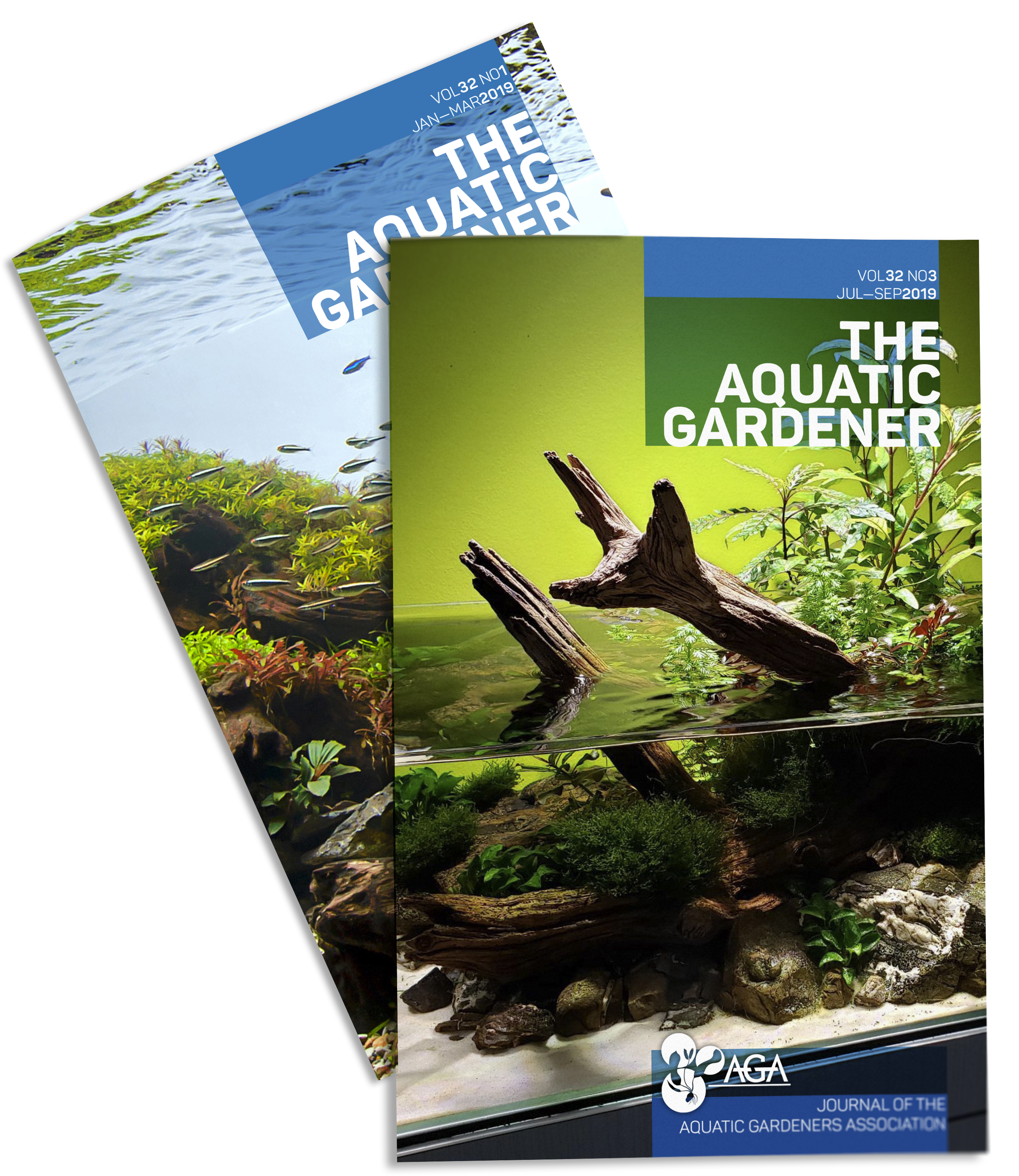
The Aquatic Gardener Magazine
Membership has its privileges—such as a subscription to the award-winning quarterly journal The Aquatic Gardener, available in both print and digital formats, access to the digital archive of all published issues as well as video from our convention speakers dating back 25 years. With more exciting projects on the horizon you’ll be part of a unique community of aquatic plant and aquascaping fans eager to expand our side of the aquarium hobby.
Our 2026 Sponsors
Premier Sponsor

Executive Sponsors





Associate Sponsors


Club Sponsors