#1018 Igarapé do Daracuá – Shallow Blackwater Habitat of the Middle Rio Negro
Shallow blackwater forest stream, Igarapé do Daracuá, Middle Rio Negro, near Barcelos, Amazonas, Brazil.


- Filter
- SunSun HBL 801.
- CO2 System
- No CO₂ injection.
- Lighting
- DIY LED light fixture.
- Substrate
- Fine beige river sand, covered in places by a natural layer of dried leaves and small organic debris. The substrate represents the sandy bottom characteristic of the shallow blackwater stream.
- Hardscape Materials
- Natural driftwood, exposed roots, small branches, twigs and dried leaf litter, arranged to recreate the submerged structure of the flooded Amazonian forest.
- Background
- No artificial background. The rear glass remains transparent, allowing the wall behind the aquarium to remain naturally visible.
Species
Paracheirodon axelrodi (Cardinal Tetra).
Plant species
Eleocharis sp.
Fertilization
No fertilization. The aquarium is maintained without conventional plant fertilizers, reflecting the very low aquatic plant biomass of the natural habitat.
Biotope Information
This aquarium recreates a shallow blackwater habitat of the Igarapé do Daracuá, near Barcelos, in the middle Rio Negro region of Amazonas, Brazil. The habitat represents a small forest stream flowing through seasonally flooded Amazonian forest. The underwater environment is characterized by fine pale sand, submerged roots, fallen branches, twigs and leaf litter. The water is naturally stained dark amber to tea-brown by tannins and humic substances released by decomposing leaves and wood. The habitat is soft, acidic and very low in dissolved minerals, with slow-moving water and seasonal changes in water level. The aquarium intentionally follows a classic Amazonian blackwater biotope approach, without artificial CO₂ or fertilization. Only small, carefully placed patches of Eleocharis sp. are used as subtle details to enhance naturalness, while the dominant visual elements remain the sand, roots, branches, leaf litter and tannin-stained water. Paracheirodon axelrodi (Cardinal Tetra) is the only fish species kept in the aquarium. The schooling behavior and intense blue and red coloration of the Cardinal Tetra contrast naturally with the dark water and shaded environment, reproducing a characteristic visual feature of the Rio Negro blackwater habitat. The composition was designed to recreate the shallow margins of the flooded forest, where fish move among submerged roots and branches beneath filtered sunlight. The aquarium aims to reproduce not only the visual appearance, but also the ecological character of this Amazonian blackwater environment. References used for accuracy include published descriptions and scientific literature on the Igarapé do Daracuá and Middle Rio Negro blackwater habitats, including Amazonas Magazine.
Quick Stats
- Style
- Biotope
- Size
- 70x45x30 cm
- Volume
- 94 L (24.8 gal.)
- Plant Species
- 1
- Fish Species
- 1
Judges' Comments
A very convincing blackwater habitat with beautifully natural organic materials, vegetation and an effective overall composition. The main weakness is that the glass boundaries remain obvious, which interrupts the impression of looking into a continuous natural environment.
— Tai Strietman
I have had the honor of snorkeling in Igarapé do Daracuá, so I particularly appreciate seeing this habitat represented in an aquascape. This is a very beautiful aquarium, and I commend the effort that went into recreating this environment. However, I believe there are opportunities to make the biotope more representative of its natural habitat through the use of finer substrate, additional leaf litter, and seed pods. Incorporating these elements would help capture more of the habitat's natural complexity and authenticity.
— Kapil Mandrekar
A very nice representation of a Rio Negro blackwater habitat, with a good sense of depth and plenty of open swimming space for the cardinal tetras. I particularly like the vertical branches, which give the impression of vegetation emerging through the water's surface, as well as the inclusion of some plants. I would have preferred a slightly finer substrate to better reflect the sandy streambed. While I appreciate the creativity of the hardscape, I feel the very thick driftwood dominates the composition and doesn't quite work with the finer vertical elements. More vertical branches and a less bulky central structure could have created a more cohesive and natural-looking scene in my view. The cardinal tetras are certainly appropriate, but given the extraordinary biodiversity of this region, I would have loved to see a little more variety in the aquatic life represented. Overall, a convincing and attractive biotope with some lovely details.
— Rodrigo Silva
Come Grow with The Aquatic Gardeners Association.
Since 1985 the Aquatic Gardeners Association has been the standalone organization focused on promoting aquatic plants, education, aquascaping, and fostering the community of planted aquarium enthusiasts.
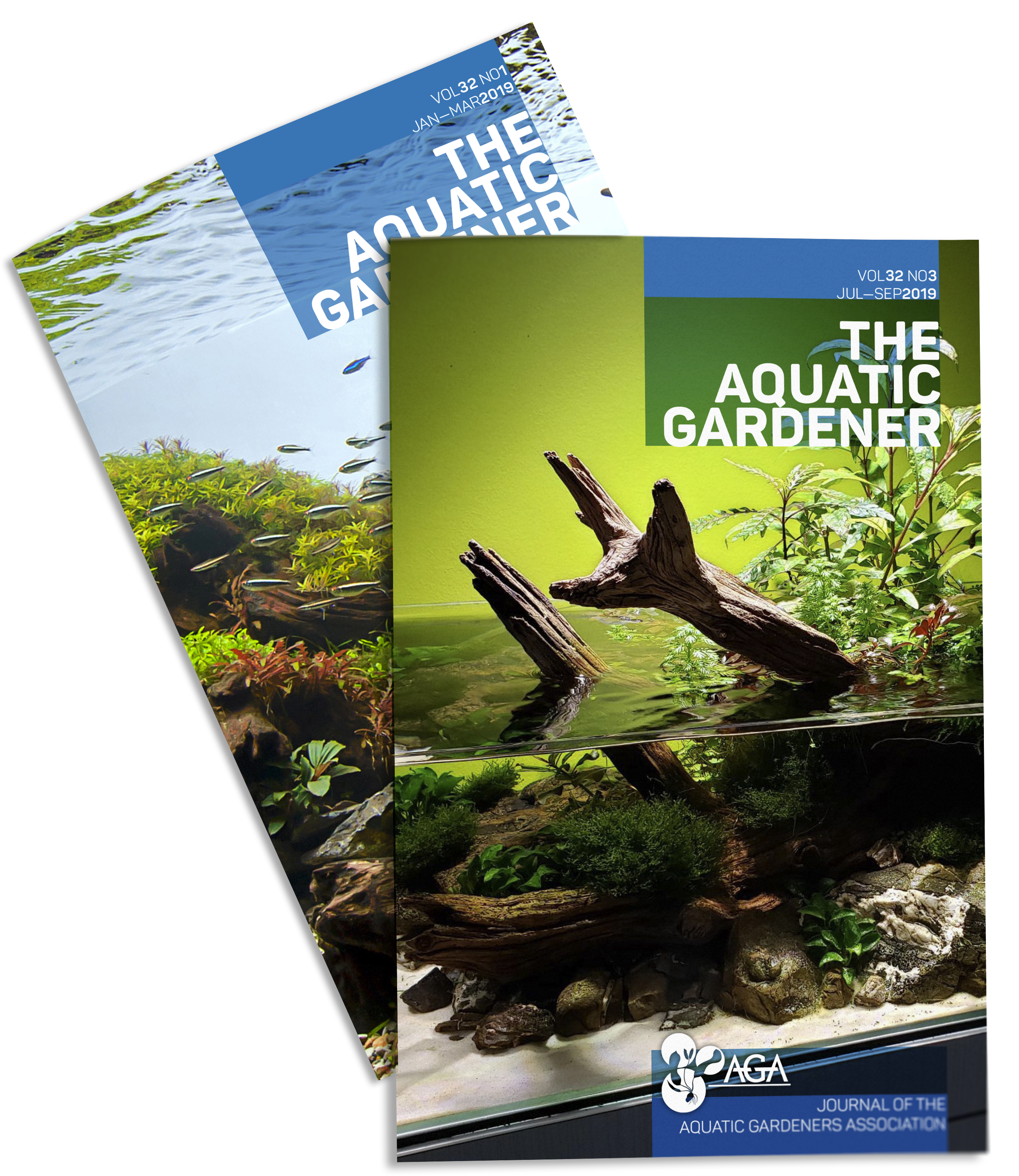
The Aquatic Gardener Magazine
Membership has its privileges—such as a subscription to the award-winning quarterly journal The Aquatic Gardener, available in both print and digital formats, access to the digital archive of all published issues as well as video from our convention speakers dating back 25 years. With more exciting projects on the horizon you’ll be part of a unique community of aquatic plant and aquascaping fans eager to expand our side of the aquarium hobby.
Our 2026 Sponsors
Premier Sponsor

Executive Sponsors





Associate Sponsors


Club Sponsors